

Rand-Whitney Completes Life Cycle Assessment

We view sustainability as more than a passing trend; it’s a responsibility that we are committed to upholding. An investment made in continuous improvement requires real data to substantiate statements and lay the groundwork for forward progress. That’s why we are proud to announce the completion of a cradle-to-grave Life Cycle Assessment for Rand-Whitney Container corrugated products and quantified product carbon footprint using IPCC AR6 global warming factors.
What is a Life Cycle Assessment (LCA)?
A Life Cycle Assessment is a report that helps benchmark a product’s impact on the environment. It considers every stage of a product’s life to put together a complete picture. An LCA evaluates energy used, resources consumed, waste created and emissions released at each step. Measurable, transparent, science-based.
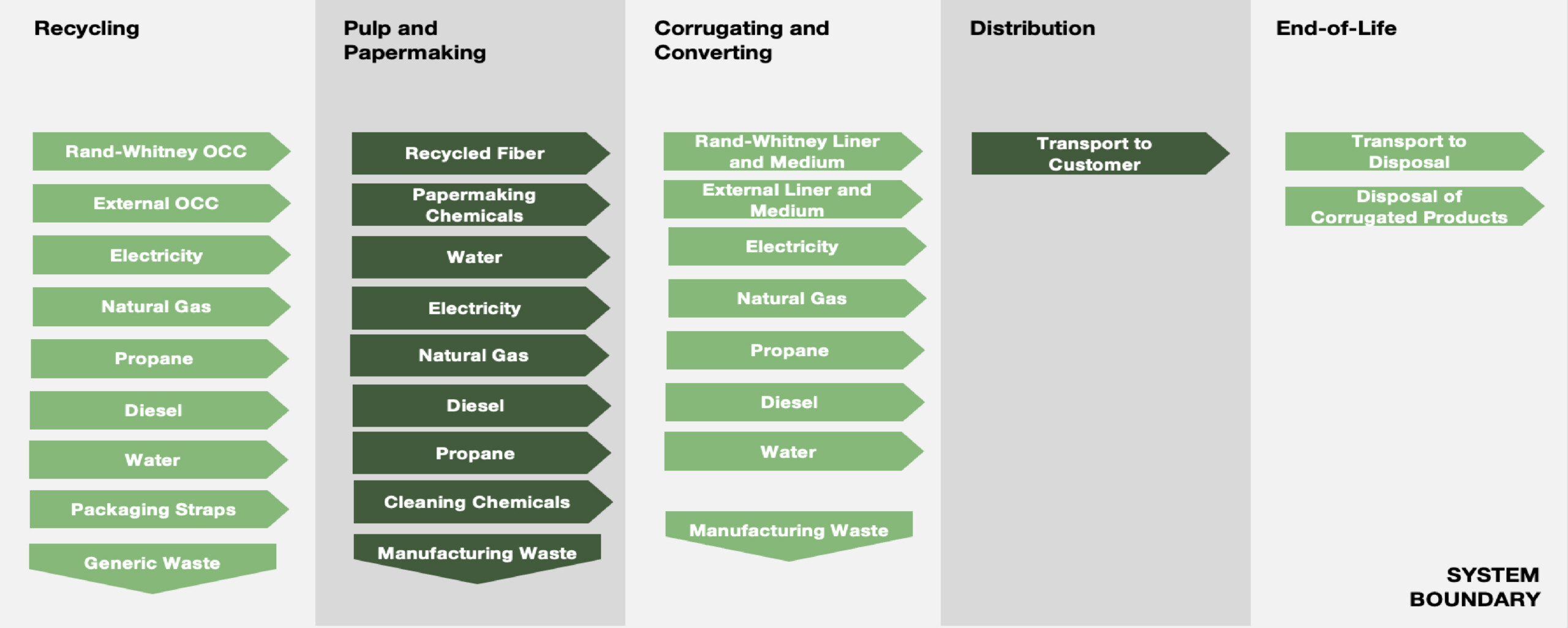
Our Lifecycle Stages
- Raw material sourcing
- Paper production
- Packaging corrugation and converting
- Transportation & distribution
- End-of-life: recycling or disposal
Why is it important to our customers?
Our customers increasingly need product level data to support Scope 3 reporting, packaging decisions, and sustainability requirements, so we focus on transparency and defensible methods.
Scope 3 emissions encompass a large portion of a company’s total footprint.
- Scope 1: Emissions from your own facilities
- Scope 2: Emissions from the energy you purchase
- Scope 3: Everything else – including the sourcing, transportation, and end‑of‑life of the materials you use
The challenge? Scope 3 is influenced by your suppliers. It requires knowing the environmental impact of the materials and packaging you rely on every day.
Our Results
Our cradle-to-grave product carbon footprint, excluding biogenic carbon, is less than 1 kg of CO2e per kg for all our products. These results have validated our past efforts while motivating us to continue our push for improvement.